
In short. Before an operation is chosen, a face is measured, photographed, and understood. What structured facial analysis involves, and why it decides the plan.
Key points
- Standardised photographs — frontal, oblique, profile, and basal views, taken under consistent light and at a fixed distance — are not marketing material.
- They are the baseline against which swelling, healing, and the final result are judged months later.
- Without them, both surgeon and patient are relying on memory.
Facial aesthetic surgery begins with measurement, not with an operation. Before any plan is proposed, a surgeon should be able to describe your face in proportions, in tissue quality, and in movement — and to say which of those findings surgery can change and which it cannot. This is what structured facial analysis means, and it is the step that separates a plan from a template.
Proportions and the profile line
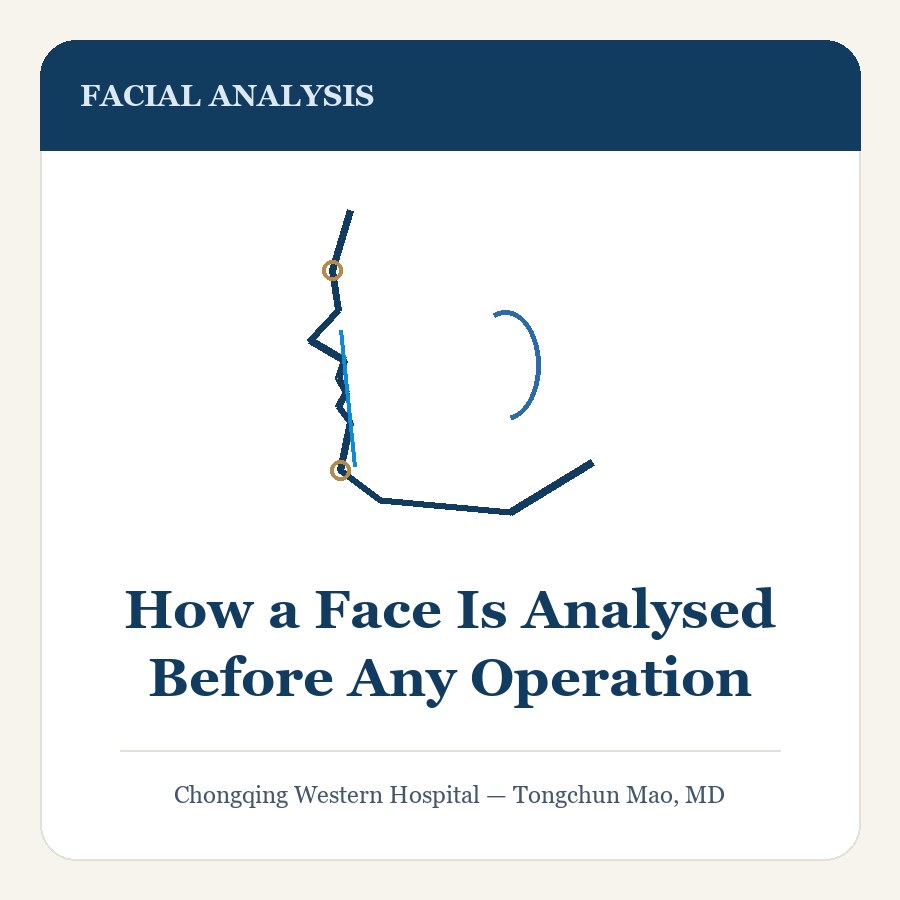
Analysis starts with the skeleton and the soft tissue envelope over it. Frontal views are read for symmetry, facial thirds, and the relative width of the cheekbone, the jaw angle, and the chin. Profile views are read along guide lines drawn from the brow through the nasal dorsum to the lips and chin. These lines are not rules about beauty; they are a shared vocabulary for describing how far forward or back each structure sits, so that a proposed change can be discussed in millimetres rather than in adjectives.
Skin, fat, and the tissues that age
The same underlying bone can look entirely different under thick or thin skin. Analysis therefore records skin thickness and elasticity, the position of the fat compartments, the strength of the retaining ligaments, and how much laxity there is. A thick-skinned nose tolerates grafting differently from a thin one. A face with good skin quality but descended tissue needs a different operation from one with thin skin and volume loss. Choosing an operation before assessing these factors is how results turn out heavy or unnatural.
Photographs are part of the record
Standardised photographs — frontal, oblique, profile, and basal views, taken under consistent light and at a fixed distance — are not marketing material. They are the baseline against which swelling, healing, and the final result are judged months later. Without them, both surgeon and patient are relying on memory.
Function before appearance
Facial analysis is never only aesthetic. Breathing through the nose, the position of the eyelid margin, the strength of the facial nerve branches, and the health of the teeth and jaw all constrain what can safely be done. A nose that looks straight but cannot breathe is a failed operation. Analysis therefore includes examination of the nasal airway and septum, of eyelid closure and the tear film, and of the dental occlusion where jaw surgery is being considered.
Analysis should tell you what not to do
- If no clear anatomical finding supports a change, the change is decoration, not surgery.
- If the goal requires tissue that is not there, no technique will manufacture it.
- If the plan changes your face beyond what you asked for, the plan is wrong.
The output of analysis is a short, honest list: what can be improved, what will be left alone, what the operation costs in scar, swelling, and time, and what the realistic range of results looks like. Any plan that arrives before that list is not a plan — it is a preference.
Frequently asked questions
Why does facial surgery begin with measurement?
Because a surgeon should be able to describe your face in proportions, in tissue quality and in movement, and to say which findings surgery can change and which it cannot. Choosing an operation before assessing those factors is how results turn out heavy or unnatural.
Why are standardised photographs taken?
They are not marketing material. Frontal, oblique, profile and basal views under consistent light at a fixed distance are the baseline against which swelling, healing and the final result are judged months later. Without them, both surgeon and patient are relying on memory.
Does facial analysis consider function as well as appearance?
Yes. Breathing through the nose, the position of the eyelid margin, the strength of the facial nerve branches, and the health of the teeth and jaw all constrain what can safely be done. A nose that looks straight but cannot breathe is a failed operation.
Risks & Limitations
- Bruising and swelling lasting weeks; after bone surgery, months pass before the final result is visible.
- Scars are permanent. They mature and fade over 6–12 months but never disappear.
- Numbness or altered sensation, which may be temporary or, after bone or nerve work, lasting.
- Asymmetry, under-correction or over-correction; final assessment is made at 6–12 months.
- Infection, bleeding or haematoma, which may need drainage or antibiotics.
- Breathing changes after nasal surgery, which may be temporary or require further treatment.
- Revision surgery carries higher risk and is less predictable than a first operation.
When to Seek Care
- Difficulty breathing or shortness of breath — seek emergency care immediately.
- Rapidly expanding swelling, or a tense, painful, tight area.
- Fever above 38 °C, spreading redness, warmth or pus.
- Bleeding that does not stop with gentle pressure.
- Any sudden change in vision after facial surgery or a facial injection.
References & Further Reading
- American Society of Plastic Surgeons (ASPS) — procedure and safety guidance
- International Society of Aesthetic Plastic Surgery (ISAPS)
- National Institute for Health and Care Excellence (NICE, UK) — relevant guidance
- Cochrane Library — systematic reviews in facial plastic surgery
This page is patient education, not medical advice, and it does not cite individual studies. Discuss your own case with a qualified clinician. To arrange an assessment at Chongqing West District Hospital, see Contact & Consultation.